Insider Report: Top 5 Tech Disrupting Film Production by 2026
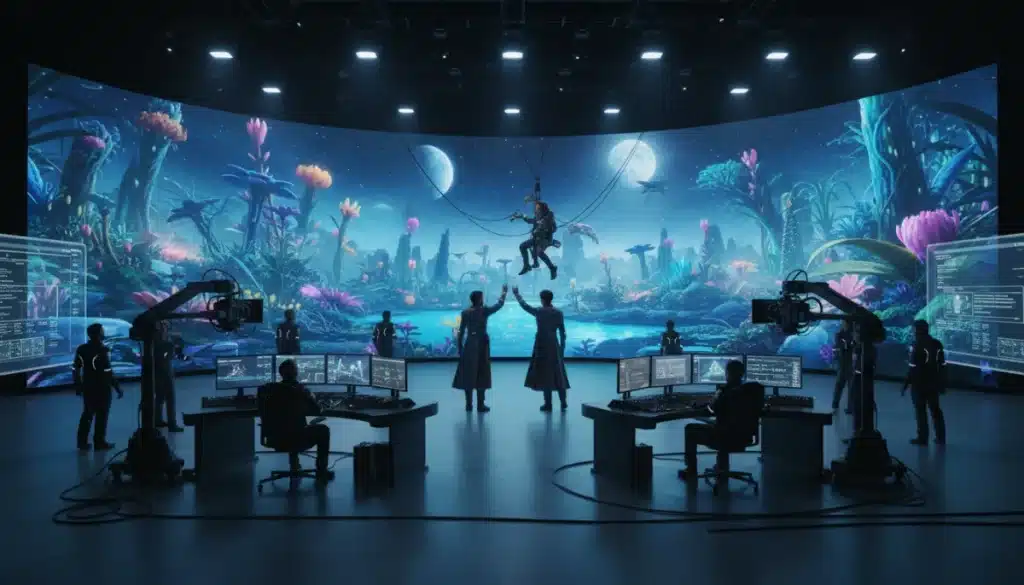
The film industry is on the cusp of a major transformation, with five key technologies poised to disrupt traditional production methods by 2026, offering unprecedented creative and efficiency gains.
The landscape of cinema is perpetually evolving, but the pace of change has accelerated dramatically. An Insider Report: The Top 5 Technologies Disrupting Film Production by 2026 reveals a future where creativity is unbound by traditional limitations, and efficiency reaches new heights. This isn’t merely an upgrade; it’s a fundamental reimagining of how stories are brought to the screen.
The Rise of Virtual Production Stages
Virtual production, once a niche concept, is rapidly becoming a cornerstone of modern filmmaking. By 2026, its integration will be widespread, transforming how directors and cinematographers approach set design and visual effects. This technology allows real-time rendering of digital environments, providing immediate feedback and unparalleled creative control during principal photography.
Filmmakers can now shoot actors against dynamic, photorealistic backdrops that react to camera movement and lighting changes instantly. This eliminates many post-production headaches and significantly reduces the need for extensive green screen work. The immersive nature of virtual sets also benefits actors, allowing them to perform within the context of their digital world rather than an empty stage.
Key Advantages of Virtual Production
- Real-time Visualization: Directors see the final shot as it’s being filmed, making immediate creative decisions.
- Cost Efficiency: Reduces travel, location scouting, and extensive set construction expenses.
- Creative Freedom: Enables the creation of impossible or impractical environments with ease.
- Improved Actor Performance: Provides a more immersive and reactive environment for performers.
The growth of virtual production is not just about aesthetics; it’s about fundamentally altering the workflow. Studios are investing heavily in LED volumes and specialized software, indicating a long-term commitment to this transformative technology. The ability to iterate and refine visual elements on the fly speeds up production cycles and fosters a more collaborative environment between departments.
AI and Machine Learning in Pre-Production and Post-Production
Artificial Intelligence (AI) and Machine Learning (ML) are no longer futuristic concepts but integral tools in the film production pipeline. By 2026, their influence will span from script analysis to final color grading, streamlining processes and unlocking new creative possibilities. AI-powered algorithms can analyze scripts for market viability, character arcs, and even potential audience reception, providing invaluable insights early in development.
Anúncios
In post-production, AI is revolutionizing tedious and time-consuming tasks. Automated rotoscoping, intelligent upscaling of footage, and even preliminary color correction can be handled by sophisticated algorithms, freeing up human artists for more complex and creative endeavors. This shift allows for faster turnarounds and more efficient use of resources, making high-quality productions more accessible.
AI-Driven Tools Enhancing Efficiency
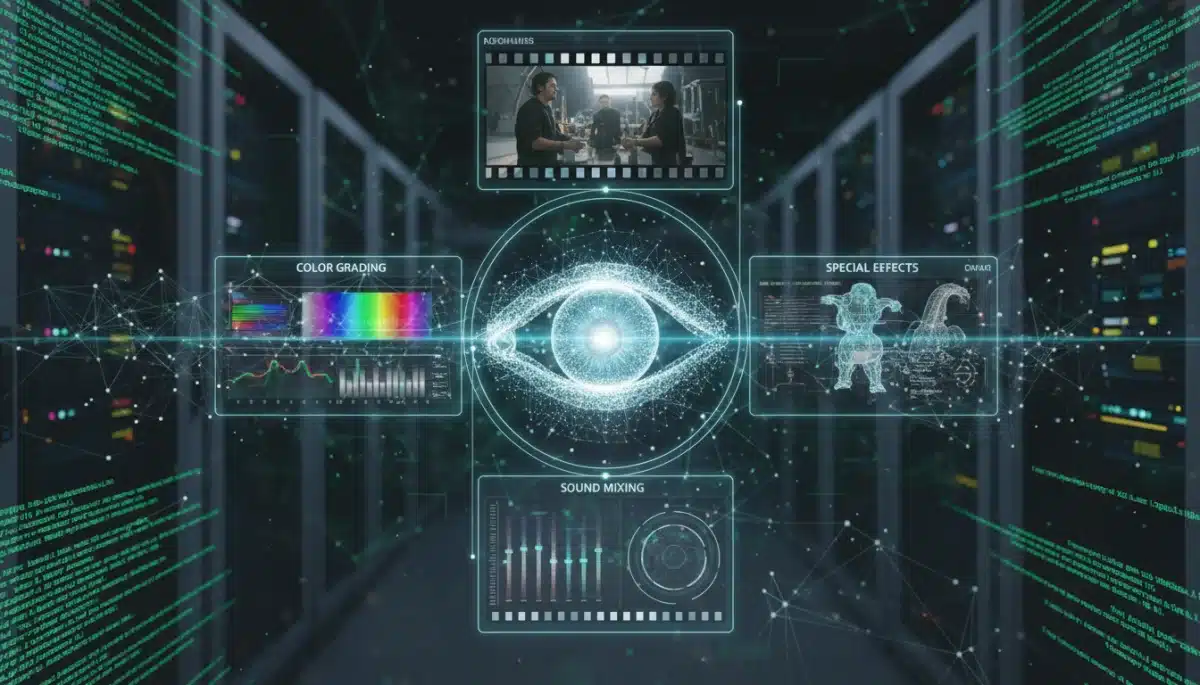
Consider the impact of AI on visual effects. Tasks that once took weeks, such as removing unwanted objects from a scene or generating realistic crowd simulations, can now be executed in a fraction of the time. This not only accelerates the post-production phase but also allows for more ambitious visual storytelling. Machine learning models are also improving sound design, automatically identifying and isolating dialogue, music, and sound effects for easier mixing.
- Script Analysis: Predicting audience engagement and optimizing narrative structures.
- Automated Editing: Assisting editors with initial cuts and scene sequencing.
- Visual Effects Acceleration: Speeding up rotoscoping, tracking, and object removal.
- Sound Design Enhancement: Intelligent audio separation and noise reduction.
The integration of AI and ML isn’t about replacing human talent but augmenting it. These technologies act as powerful assistants, handling repetitive tasks and providing data-driven insights that empower filmmakers to make more informed decisions and focus on the artistic core of their work. The future of film production technology 2026 is undoubtedly intelligent.
Advanced Robotics and Drones for Cinematography
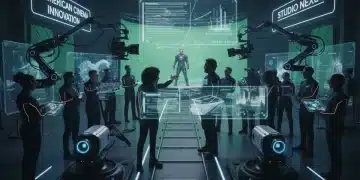
The evolution of robotics and drone technology is redefining what’s possible in cinematography. By 2026, advanced robotic camera systems and highly sophisticated drones will offer unprecedented shot versatility and precision. These tools can execute complex camera movements with consistent accuracy, opening up new creative avenues that were previously too dangerous, expensive, or technically challenging.
Robotic arms, often seen in industrial settings, are now being adapted for film sets, capable of replicating precise camera paths repeatedly, which is invaluable for visual effects shots requiring multiple passes. Drones, meanwhile, have moved beyond simple aerial shots, offering stabilized, high-resolution footage from dynamic perspectives that would be impossible with traditional cranes or dollies. Their ability to navigate tight spaces and achieve unique angles is transforming action sequences and establishing shots.
Robotics and Drones: Expanding Cinematic Horizons
The precision offered by these technologies ensures that every take can be identical, a critical factor for VFX compositing. Furthermore, the safety implications are significant, allowing hazardous shots to be captured without putting human camera operators in risk. This combination of safety, precision, and creative freedom makes advanced robotics and drones indispensable tools for film production technology 2026.
Consider the efficiency gains: a single robotic arm can perform the work of several human operators, and advanced drones can capture sweeping vistas in minutes. This not only saves time but also reduces crew size on certain types of shoots, contributing to overall budget efficiency. The ongoing development of these systems promises even greater capabilities in the near future.
Real-time Cloud Collaboration and Remote Workflows
The pandemic accelerated the adoption of remote work, and by 2026, real-time cloud collaboration will be standard practice in film production. This technology enables teams to work together seamlessly from anywhere in the world, breaking down geographical barriers and fostering a more inclusive and efficient production environment. From script development to post-production, cloud-based platforms are streamlining every stage of the filmmaking process.
Editors, VFX artists, sound designers, and directors can review and approve footage, make annotations, and communicate in real-time, regardless of their physical location. This not only reduces travel costs and logistical complexities but also allows productions to tap into a global talent pool, securing the best professionals for each role. Security protocols for cloud storage and data transfer are also evolving rapidly to protect sensitive production assets.
Benefits of Cloud-Based Production
- Global Talent Access: Collaborate with experts worldwide without relocation.
- Increased Efficiency: Faster review cycles and instant feedback.
- Cost Reduction: Less travel, fewer physical infrastructure needs.
- Enhanced Security: Robust cloud platforms offer advanced data protection.
The ability to instantly share large media files and collaborate on complex projects in real-time is a game-changer. It means that a director in Los Angeles can review an edit from an editor in London, with a colorist in Sydney making adjustments simultaneously. This interconnected workflow ensures that projects can progress around the clock, significantly shortening production timelines and enhancing overall productivity. This is a critical aspect of film production technology 2026.
Immersive Storytelling with Extended Reality (XR)
Extended Reality (XR), encompassing Virtual Reality (VR), Augmented Reality (AR), and Mixed Reality (MR), is set to revolutionize not just how films are made, but how they are experienced. By 2026, XR will move beyond niche applications and become an integral part of immersive storytelling, offering audiences new ways to interact with cinematic narratives. This technology allows filmmakers to create truly interactive and personalized experiences, blurring the lines between spectator and participant.
Filmmakers are already experimenting with VR films that place viewers directly within the story, allowing them to explore environments and influence outcomes. AR applications can enhance the viewing experience by overlaying digital information onto the real world, adding layers of narrative depth. MR takes this further, blending digital objects seamlessly into physical spaces, creating truly hybrid realities.
XR: The Next Frontier in Audience Engagement
The potential for XR in film extends beyond just viewing. It can be used in pre-visualization, allowing directors to scout virtual locations or block scenes in a 3D environment before stepping onto a physical set. This not only saves time and money but also provides a deeper understanding of spatial relationships and camera angles. The interactive nature of XR also opens up new revenue streams and engagement models for content creators.
- Interactive Narratives: Audiences can influence story outcomes.
- Enhanced Pre-visualization: Virtual set scouting and scene blocking.
- New Distribution Channels: Creating unique experiences for VR headsets and AR devices.
- Deeper Immersion: Blurring the lines between the film world and reality.
As hardware becomes more accessible and powerful, XR will become a mainstream medium for cinematic experiences. The ability to create personalized and deeply engaging stories will attract new audiences and redefine the very definition of a film. The creative possibilities are endless, and studios are actively exploring how to harness XR to tell stories in ways never before imagined. This truly marks a new era for film production technology 2026.
Sustainable Production Practices through Technology
Beyond the creative and efficiency gains, technology is also driving significant advancements in sustainable film production. As environmental concerns grow, the industry is seeking innovative ways to reduce its carbon footprint. By 2026, sustainable practices, heavily aided by technological solutions, will be a non-negotiable aspect of major productions. This shift is driven by both ethical considerations and increasing regulatory pressures.
Virtual production, for instance, dramatically reduces the need for physical sets and extensive travel to diverse locations, thereby cutting down on waste and fuel consumption. Cloud-based workflows minimize the need for physical media and large, energy-intensive on-site servers. Furthermore, advancements in renewable energy sources are being integrated into studio operations, powering stages and post-production facilities with clean energy.
Eco-Friendly Innovations in Filmmaking
Smart energy management systems are becoming common, optimizing power consumption on sets and in studios. Waste reduction technologies, such as advanced recycling and upcycling programs for props and costumes, are also gaining traction. The focus is on a holistic approach to sustainability, where every stage of production is scrutinized for its environmental impact. This commitment to green filmmaking is not just a trend but a necessary evolution for the industry’s future.
- Reduced Physical Waste: Virtual sets minimize material consumption.
- Lower Carbon Footprint: Less travel, optimized energy use, renewable sources.
- Efficient Resource Management: Cloud platforms reduce physical infrastructure.
- Eco-Conscious Supply Chains: Sourcing sustainable materials for props and costumes.
The financial incentives for sustainable practices are also becoming clearer, with many governments offering tax breaks and grants for eco-friendly productions. This convergence of technological innovation, environmental responsibility, and economic viability ensures that sustainable film production technology 2026 will be a defining characteristic of the industry. It’s about creating compelling stories responsibly.
| Key Technology | Brief Impact by 2026 |
|---|---|
| Virtual Production | Real-time digital environments, reduced physical sets, enhanced creative control. |
| AI/Machine Learning | Automated tasks in pre/post-production, script analysis, VFX acceleration. |
| Robotics & Drones | Precision cinematography, complex shots, enhanced safety, dynamic perspectives. |
| Cloud Collaboration | Global talent access, real-time remote workflows, increased efficiency. |
Frequently Asked Questions About Film Production Technology in 2026
By 2026, virtual production will significantly reduce reliance on physical sets and green screens. Directors will be able to visualize and adjust digital environments in real-time on LED volumes, leading to more efficient shoots and a seamless integration of physical and digital elements during principal photography.
AI will automate many labor-intensive post-production tasks such as rotoscoping, object removal, and initial color grading. This allows human artists to focus on higher-level creative decisions, accelerating workflows and making complex visual effects more accessible and cost-effective for various productions.
No, drones and robotics are augmenting human camera operators, not replacing them. These technologies provide unparalleled precision for complex shots, access to dangerous locations, and the ability to achieve dynamic camera movements that would be impossible or unsafe for humans, expanding creative possibilities.
Cloud collaboration will enable seamless remote workflows, allowing filmmakers to work with talent globally without geographical constraints. This fosters greater diversity, reduces travel costs, and accelerates production timelines through real-time feedback and shared access to project assets from anywhere in the world.
Extended Reality (XR) encompasses VR, AR, and MR, offering immersive storytelling. By 2026, it will create interactive cinematic experiences where audiences can participate in narratives. Filmmakers will also use XR for advanced pre-visualization, designing sets and blocking scenes in virtual 3D environments.
Conclusion
The film industry is on an irreversible trajectory towards greater technological integration, with these five innovations — virtual production, AI, advanced robotics and drones, cloud collaboration, and XR — leading the charge. By 2026, these tools will not merely be enhancements but fundamental components of the filmmaking process, driving unprecedented levels of creativity, efficiency, and sustainability. As creators embrace these advancements, the future promises a more dynamic, immersive, and globally connected cinematic landscape, redefining how stories are told and experienced.